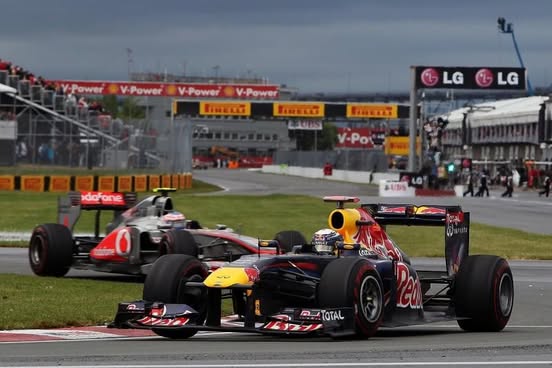
Over the years, there have been more than 1,000 races in F1 history. Among them, many have stood out. Some featured dramatic finishes in the final corners, others were marked by changing conditions, interruptions, accidents, safety cars, and so on. But one race in particular managed to combine all of the above and keep us on edge right up until the chequered flag.
We go back to (relatively) distant 2011, a season that had started with several changes compared to 2010. Pirelli had just become the exclusive tire supplier for the entire grid, KERS (Kinetic Energy Recovery System) — which allowed drivers to convert braking energy into power — had returned, and for the first time, DRS (Drag Reduction System), the now-famous movable rear wing that gave attackers better top speed on straights, had been introduced.
As for the championship, the season had started with Red Bull leading the way and its champion Sebastian Vettel already laying a solid foundation for a second consecutive title by winning five of the first six races, building a gap over second-place Lewis Hamilton worth more than two race victories.
And so, we arrive at the race weekend of June 10–12 for the seventh round of the championship in Montreal, Canada. With Saturday’s qualifying sessions won by the unstoppable Sebastian Vettel, the German had already taken the first step toward claiming his sixth win of the season. However, for the 70-lap race on Sunday, nothing was certain — just like the skies over Montreal.
The starting grid for the top 10 was as follows: Sebastian Vettel, Fernando Alonso, Felipe Massa, Mark Webber, Lewis Hamilton, Nico Rosberg, Jenson Button, Michael Schumacher, Nick Heidfeld, and Vitaly Petrov. The only driver out of the 24 not to start on the grid but from the pit lane was Jaime Alguersuari, as he had chosen to make setup changes after qualifying, which according to regulations incurred penalties.
Since the first six races had taken place in completely dry conditions, this meant that Pirelli’s two wet-weather tire types — intermediates and full wets — had never been tested in race conditions. So with the track already wet, race director Charlie Whiting deemed it necessary to start the race behind the safety car, with all drivers mandated to use full wet tires. Until the track was declared safe, overtaking was forbidden and the pace was limited.
So, although the official local start time was 13:00, the race began a few minutes later. After four laps, the safety car pulled in for the first time. And from the very first seconds, chaos ensued. In Turn 2, battling for 4th place, Mark Webber and Lewis Hamilton made contact, sending them down to 14th and 7th respectively. Everyone was not only fighting each other but also struggling to keep their cars on the track.
As the first lap under race conditions ended, Vettel was already showing he wouldn’t be challenged much, setting the fastest lap and continuing to improve, pulling away from the rest. But that didn’t last long. At the end of lap 7, Lewis Hamilton attempted to overtake his McLaren teammate Jenson Button. Likely due to limited visibility in the rain, Hamilton found himself squeezed between Button and the wall, resulting in a collision. A few corners later, Hamilton had to retire, and Bernd Mayländer (the safety car driver) returned to set the race pace again.
After the restart, track conditions started to improve, and many drivers switched from full wets to intermediates, shaking up the order. Button had to visit the pit lane a second time shortly after, as he had exceeded the speed limit under safety car conditions and was handed a drive-through penalty. By lap 18, the rain returned — this time more heavily. One lap later, the safety car was back. Six laps after that, the race was red-flagged. Everyone now just had to wait for the downpour to ease.
Finally, at 15:50 local time, we had déjà vu of 13:00 — another safety car stint with full wet tires for everyone. Vettel still led, but we were now on lap 26 and the pit stops had reshuffled the midfield.
After the fourth safety car exit on lap 34, the race resumed, with Vettel pulling away again. Kamui Kobayashi found himself second on the restart, having taken a gamble and not changed tires once before the red flag.
The track slowly dried, meaning full wets were gone for good. But just as the racing picked up… drama again. On lap 37, Button collided with Fernando Alonso at Turn 3. Alonso spun and parked helplessly at the edge of Turn 4, while Button suffered a puncture. Once again, the safety car neutralized the race. And with Button now 21st and last of the remaining runners after his fourth pit stop, he had a mountain to climb.
On lap 40, the safety car withdrew yet again. The rain had stopped, the track was drying, Vettel pulled away, and battles started behind him. Massa was fighting Kobayashi for second, but seven-time champion Michael Schumacher overtook them both, while Button was climbing — up to P10.
Intermediate tires were also becoming obsolete. Despite water on the track, a dry racing line had formed. Time for slicks. After pit stops, the fastest drivers were Webber and Button, climbing the ranks. Vettel had a comfortable gap, while Massa made a mistake while trying to lap a slower car, stepped on a wet patch, damaged his front wing, and had to pit.
Kobayashi was also struggling as the track dried, being passed easily by quicker cars. He remained in the points, but a podium was slipping away. When he had to defend from Nick Heidfeld on lap 56… he didn’t actually have to. A minor contact between them dislodged Heidfeld’s front wing, which got trapped under his car, making it uncontrollable. Heidfeld retired in the Turn 3 runoff area. And yes, Bernd Mayländer came out for the sixth time to erase the gaps.
By nearly 17:00 local time, on lap 60, the safety car left the track, and weirdly enough wouldn’t return. Vettel now had to defend the lead he had held all race for 10 more laps from Schumacher, Webber, and Button. On lap 64, Webber attempted a move into the final chicane, lost the rear briefly, and dropped behind Button. One lap later, Button passed Schumacher, and now, after this massive and chaotic race, had to close a 4-second gap in 5 laps to take the win.
Approaching the two-hour time limit (excluding the red flag) and entering the final lap, Button was glued to Vettel’s gearbox — but not close enough to pass. Only a mistake could cost Vettel the win.
And that’s exactly what happened. In Turn 6, Vettel touched a wet patch, ran slightly wide, and Button seized the moment — taking the lead and crossing the line first, despite leading for less than one lap in the entire race.
As Button himself said afterward, “That might be my best victory ever.” Understandably so — in a spectacular race, with multiple penalties and pit stops, he had to overtake the same drivers several times, fight countless battles, and finally pass the long-time leader on the last lap. One of the most incredible races of all time, which also broke records:
- No other race to this day has had more than 5 safety car deployments
- No other winner has visited the pit lane 6 times (5 for tires, once for a penalty)
- Τotal length of the Grand Prix: 4 hours, 4 minutes, and 39 seconds. A record unlikely to ever be broken, due to rule changes on race duration
To be honest, I really wish we had more races like this one. Sure, not every race is boring, but we don’t get to see races like that very often. In future articles, we’ll break down a few more of those. Finally — if you’d like to see it for yourself and not just read about it, so you can relive, even in part, what we experienced live back then, here’s the link from F1’s official YouTube channel:
https://www.youtube.com/watch?v=31qQsC4